Delivery is a problem of place
A treatment needs an address. The ambition behind vGPS is a whole-body atlas that makes the question of where it goes easier to ask—and harder to evade.
A medicine needs an address
If the body were a city, some forms of drug delivery would resemble dropping letters over the streets and hoping enough reach the right mailbox. The analogy is imperfect: medicine already has ways of directing treatments, and some drugs should act widely. But it captures a difficulty that remains even when we know what a treatment ought to do. Knowing its intended destination does not tell us where it will actually go.
A molecule can have the right effect in the right cell and still be a poor medicine if too little reaches that cell, or too much reaches others. Delivery belongs inside the therapeutic question. Where a treatment goes helps determine what it does.
I am interested in making that problem more legible. Before promising a better courier, could we build a better map?
Learning from biological diversity
Viruses have evolved remarkably varied relationships with the tissues they encounter. That diversity offers ideas about delivery. It also belongs to a history of infection, with consequences quite different from the ones medicine seeks. Translating a biological observation into a therapeutic possibility requires understanding those differences.
What draws me to this problem is the possibility of learning across that diversity. An isolated example can be ingenious and useful. A comparative atlas could make the examples speak to one another: where does an apparent preference recur, where does it disappear, and which assumptions fail when the view widens to the rest of the body?
The whole-body perspective matters because an intended destination is only part of the story. A promising route acquires its meaning in relation to the other places it reaches.
The ambition behind vGPS
I use vGPS—viral Global Positioning System—as a name for this ambition: a whole-body atlas of delivery possibilities. The name evokes navigation, but the aim is a map whose claims can be examined. It should help a researcher ask which possibilities deserve attention for a particular destination, and what is known about their behavior elsewhere.
A subway map is useful because it preserves the relationships that matter to a journey. It simplifies the city without pretending that the city is simple. A biological atlas has a harder task. Its stations are living tissues, its boundaries can change, and reaching the vicinity of a destination may be very different from reaching the cells that matter.
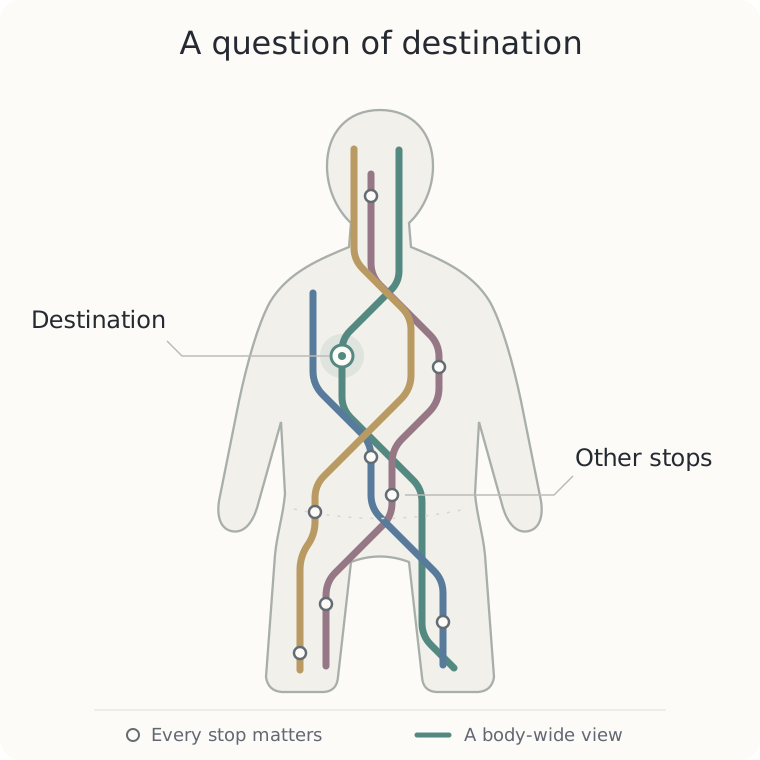
The figure below is how I picture the question. The highlighted station is an intended destination; the other stops remain visible. Their presence changes the meaning of arrival. The routes are a visual analogy, not measured paths.
Arrival is not the same as success
Selectivity is a comparison. An impressive signal at the intended site may conceal substantial exposure elsewhere. Conversely, an apparent preference may be less impressive when the full distribution is visible. A whole-body view changes what counts as a good result.
There is another distinction I want the atlas to preserve. Finding something in a tissue is not the same as showing that it reached the relevant cells, produced the intended effect, or could help a patient. These are connected questions, each with its own burden of evidence. Collapsing them into the single word targeting makes a complicated problem sound solved before it is.
An atlas would be valuable if it made those distinctions easier to keep. Its purpose would be to improve decisions about what to pursue, including when a promising idea should be reconsidered.
The map must carry its uncertainty
A blank region on a map can mean that nothing is there. It can also mean that nobody looked, that the view was too coarse, or that the instrument could not see it. Those meanings should remain distinguishable. Otherwise, the map quietly turns the limits of observation into claims about the world.
This is the same concern that runs through my essay on the point of view of an assay. A useful atlas needs to carry the conditions and limits of its evidence. The question is not simply whether a route appears on the page, but what kind of claim its appearance supports.
I would like vGPS to make uncertainty usable. A reader should be able to tell the difference between a well-supported possibility, a tentative one, and a region still awaiting a meaningful view. The map should help us ask the next question without disguising how much remains unanswered.
From relationships to destinations
My doctoral work began with relationships between proteins. The larger lesson was that a list of parts leaves out much of what makes a biological system work. Context changes the relationships; time changes their meaning. I explored that progression in From parts to histories.
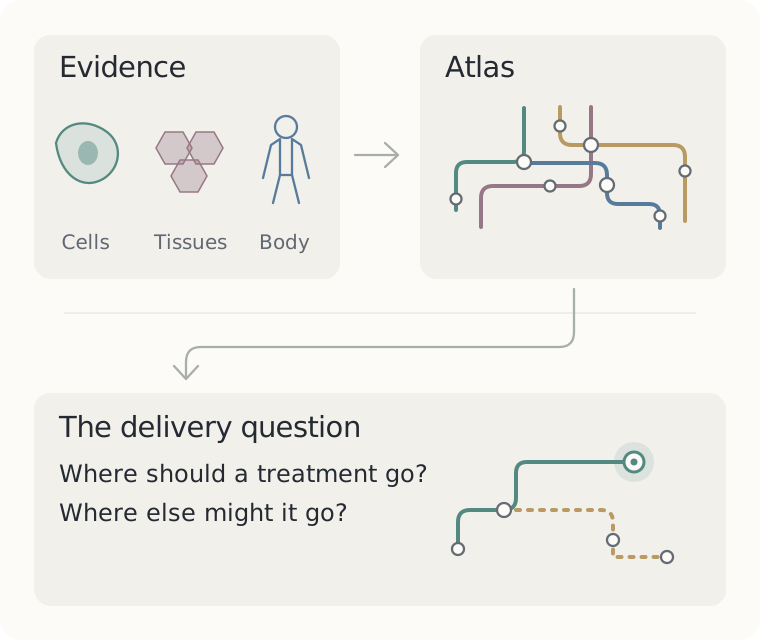
The delivery problem extends that way of thinking to another scale. A property observed in isolation has to be understood within a body. Molecular relationships, cells, tissues, and the organism are connected levels of the question. The ambition is to bring their evidence into a form that can be considered together.
There is a computational question here too. A model trained to reproduce a map may inherit the biases in what was observed. Better prediction will matter most when we understand what the prediction refers to, where it is supported, and what would challenge it. That concern connects this work to my writing about a good fit and a useful explanation.
What I hope the map makes possible
The H.L. Holmes Award supports this research direction in the Yachie Lab at UBC. The project brings together collaborators with different ways of seeing biological systems. I also helped co-found Zenbu Tx, with the hope of carrying useful discoveries towards therapeutic development.
The distant ambition is delivery that can be reasoned about across the body: choosing a destination with a clearer account of the places reached along the way. The work now is to make that ambition accountable to evidence.
A map will not, by itself, deliver a medicine. But it could change which journeys we attempt, which obstacles we recognize, and how quickly a beautiful idea becomes a question we can answer.