An assay has a point of view
A missing edge may be a biological absence, a sampling problem, or a limit of the instrument. These explanations require different experiments.
What does an edge mean?
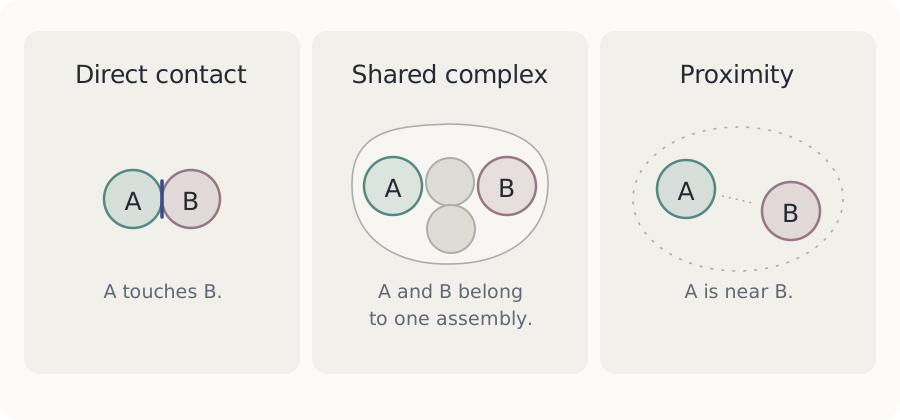
Protein interaction maps often look similar on a page: dots connected by lines. But the biological meaning of a line depends on how it was measured. A direct contact between two proteins is not the same observation as finding them in the same molecular complex. Spatial proximity is another relationship again.
Imagine three proteins in one molecular assembly. One contacts a second, which contacts a third. All three belong to the same complex, but the first and third need not touch. A map of shared complex membership can place a line between them without being wrong. A map of direct contacts would need different evidence for that line. The ambiguity arises when the drawing travels further than the experimental definition attached to it. A diagram can look more complete while the claim it makes has quietly changed.
These approaches provide complementary views. A map of complexes can reveal the modular organization of cellular machinery. A map of direct contacts can resolve relationships within and between those modules. The problem begins when we use the same visual vocabulary and forget that the experiments answered different questions.
This distinction became particularly important when different large-scale maps showed little overlap. It was understandable to question their quality. Yet later benchmarking showed that a high-throughput screen could produce interactions of comparable quality to those supported by multiple smaller studies. Limited overlap did not, by itself, establish that the maps were unreliable.
One reason was limited sampling: early screens had not exhausted the interactions detectable by their own assays. Other reasons included differences in the proteins examined and intrinsic differences between measurement systems. Even at saturation, an assay observes a subset of possible interactions. Repeating a measurement more thoroughly and changing the kind of measurement are different ways to expand that view. The benchmarking work discussed in my thesis treats this complementarity as an experimental resource: different views can reveal different real relationships.
Biophysical possibility and biological occurrence
The two-hybrid approaches I worked with ask whether proteins can interact in an experimentally defined setting. This is a biophysical question. A positive result does not guarantee that the same proteins encounter one another and bind under every biological circumstance.
The artificial setting brings both limitations and advantages. By making aspects of expression and localization more comparable, it can diminish some sources of variation. That makes it possible to investigate other sources more directly. In the dynamic interactome work, this helped us examine interaction changes that could reflect post-translational regulation, while changes in transcription could be measured separately.
The resulting observations should therefore be interpreted in the light of the assay's particular strengths and restrictions. Calling the system artificial does not make its results irrelevant. Calling an interaction reproducible does not make the system a complete replica of a cell. The useful question is which biological inference the experiment supports.
This is why I treated matched measurements as more than a way to add annotations to a network. Different modalities carry different information. An interaction assay, expression profile, and modification profile can constrain a model from different directions. Their agreement can be informative precisely because they do not all observe the same thing.
This has a consequence for comparing dynamic maps. An assay that allows protein abundance and localization to vary can register changes arising through those routes. Another assay that makes them more comparable is asking a narrower question about what else changes the relationship. The two studies need not estimate the same fraction of dynamic interactions, even when both are informative. Before asking which number is correct, we should ask whether the numbers describe the same biological quantity.
An apparent dynamic interaction
The dynamic maps introduced an additional difficulty. If a pair is detected in one environment and missed in another, it is natural to call the interaction environment-specific. But incomplete sampling can produce that pattern even when the underlying relationship has not changed.
We could see this by comparing replicate screens in the same condition. Their maps were not identical. At the same time, replicates from one condition were more similar to one another than maps from different conditions. There was biological signal in the differences, but there was also a contribution from measurement sensitivity.
To separate these explanations, interactions found in any environment needed to be retested across the environments, rather than verified only where they had initially appeared. This changed the interpretation of many apparently dynamic relationships. Some became detectable in additional conditions when measured more thoroughly. The dynamic component became smaller and better supported.
For me, this was an important result of the thesis, rather than a disappointing reduction in the number of discoveries. A larger list of changing edges would have made a more dramatic picture. But it would also have mixed biological rewiring with incomplete observation. Controlling for sampling changed what we could reasonably say about cellular plasticity.
That correction reaches beyond the map itself. A model trained on apparent gains and losses could learn patterns in the assay’s omissions and mistake them for the cell’s response. More data of the same kind would reproduce the pattern more convincingly. What improves the interpretation is evidence that separates incomplete observation from a change in the underlying relationship. This is one point at which the design of the experiment determines what an explanation can mean.
Validation changes the claim
Verification within the same measurement system and validation with an independent assay address related but distinct uncertainties. A repeated result tells us about reproducibility. An independent measurement can test whether the result survives a different experimental configuration, with different sources of error and different limitations.
Even independence needs to be understood carefully. Two assays can fail to detect the same real interaction for different reasons. Conversely, agreement between them supports a relationship without resolving every question about its physiological role. Quality assessment is not a ceremonial final step that converts a map into ground truth. It changes the precision of the claim we can make.
In a dynamic map, a negative result carries an especially heavy burden. Absence may reflect the cell, the assay, or insufficient observation. Before using it to tell a biological story, we need measurements that distinguish those possibilities. This is one reason I am interested in the design of experiments themselves, rather than treating data generation as something finished before inference begins.
The larger ambition remains to understand cellular organization. But that ambition becomes more achievable when we keep track of the point of view from which each measurement was made. A map is strongest when it makes its experimental meaning clear enough to guide another experiment: one that can test the relationship, the context, or the proposed mechanism still missing from the first view.
The same concern returns in my writing about AI. A pattern can be reproducible because the world is organized that way, or because our way of observing it is. An experimental model needs to keep both possibilities available long enough for a further measurement to distinguish them. That is a demanding form of ambition: to make a large claim answerable to a small, decisive disagreement.