The genotype–phenotype problem has a combinatorial problem embedded within it
Every gene, transcript, and protein has evolved in the presence of others. Understanding the parts is only the beginning.
Parts and their interactions
The origins of the genotype–phenotype problem, loosely defined as linking inherited variation to variation in an organism’s traits, reach back to early domestication and artificial selection, beginning roughly twelve thousand years ago. Long before there was a molecular vocabulary for inheritance, people were tracking heritable traits and selecting among them. The history of domestication is a history of working with those relationships: observing what persisted across generations, what changed, and what the resemblance between parents and offspring could tell a breeder about the next choice.
A much later image gives that argument a striking historical form. In “The Oldest Pedigree Chart,” published in 1935, Wolfgang Amschler interpreted an arrangement of animal heads from Susa as a horse genealogy. He read differences in their profiles, manes, and ears alongside their position in the diagram. His Figure 6 invites a comparison with a modern pedigree: traits are placed within a history of relationships. The roughly five-thousand-year-old object belongs to a much later period than the beginnings of domestication.
The interpretation deserves a qualification. A later account, reporting an examination of the original tablet, favored a record of animals rather than a pedigree. The breeding argument does not depend on this object being a proven genealogy. But the disagreement makes it an interesting companion to the question: a diagram can preserve visible differences while leaving us uncertain about the relationships its maker intended.
This was the point I wanted to make at the beginning of my thesis. The genotype–phenotype problem did not begin when we acquired genomes. Breeders could work with inheritance while the molecular organization underlying it remained invisible. Sequencing changes what we can observe, but the old question survives inside the new measurement: how does inherited variation become a difference in the organism? We have gained an extraordinary inventory of parts. The relationships through which those parts produce a phenotype still have to be understood.
A separate record reaches much further back. The spotted horses at Pech Merle were debated as observations of actual animals or imaginative markings. A 2011 ancient-DNA study found evidence compatible with the depicted coat patterns, including spotting, in predomestic horses. That made the pattern biologically plausible; it did not settle the artists’ intentions. The painting records a visible trait. DNA records an inherited difference. Bringing the two together sharpens the question without turning either record into a complete explanation.
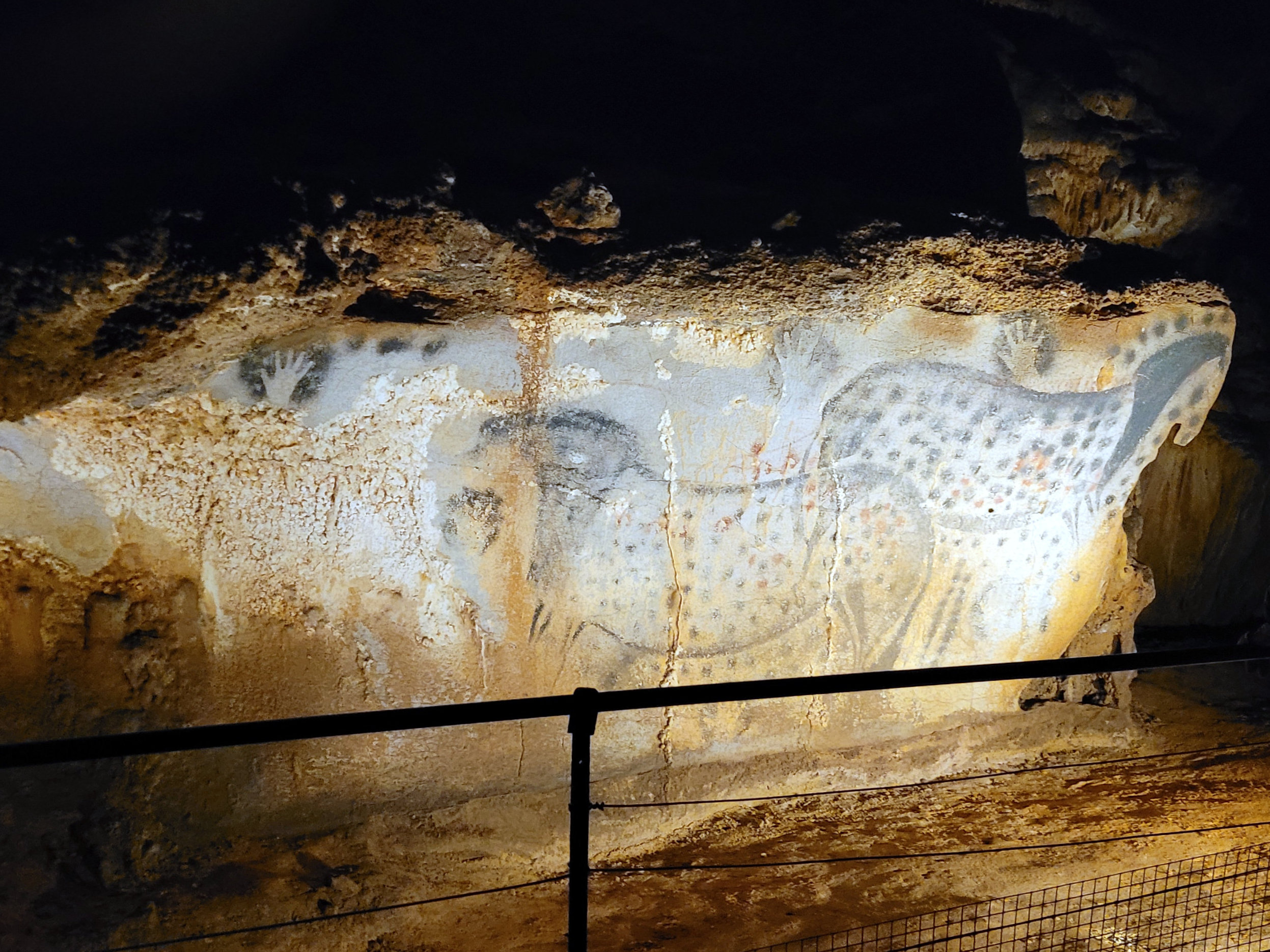
The path from a genotype to a phenotype involves many layers of biological organization, each of which influences how a genotype manifests as a phenotype. We can crudely reduce some of these layers to the genome, transcriptome, and proteome. But each layer responds to internal and external stimuli. Environmental conditions belong in the equation from the beginning, rather than being added after we have finished describing the organism.
This is a familiar problem with a less familiar difficulty embedded within it: every gene, transcript, and protein has evolved in the presence of other genes, transcripts, and proteins. A protein is not a component designed first in isolation and subsequently installed in a cell. Its properties have been shaped among other components. Linking genotype to phenotype therefore requires identifying relationships at each level of biological organization.
I opened my thesis with Sydney Brenner's observation that the whole cannot exceed the parts together with their interactions. What interested me was the experimental consequence. If we take relationships seriously, we cannot expect a complete inventory of components to provide a complete explanation of a cell. We also need to know which components can affect one another, under what circumstances, and through which physical contacts.
The puzzle becomes much larger
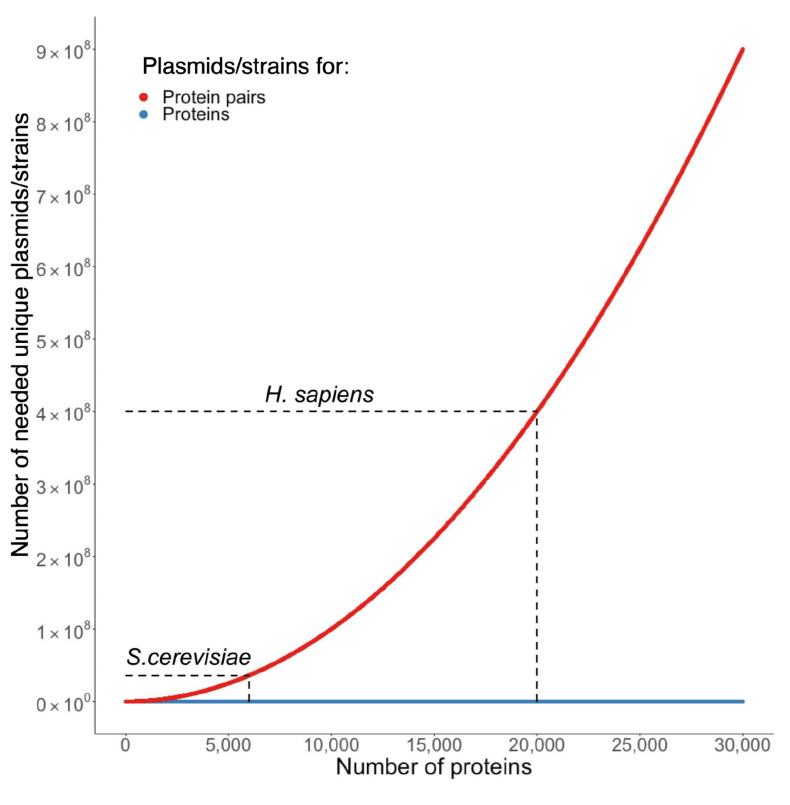
Even before considering higher-order combinations, a list of pairwise relationships can help immensely to complete the picture. I used a puzzle as an analogy: knowing which pieces fit together changes the task of assembly. Yet discovering those pairs introduces its own problem. As the number of proteins increases, the space of possible pairs grows quadratically.
For a proteome with thousands of proteins, this is an exciting but daunting search space. A study of individual proteins and a study of all their pairwise combinations are different experimental undertakings. Doubling the number of parts does not merely double the work of testing all possible relationships. Add environments, genetic backgrounds, and time points, and the space expands again.
The scale becomes concrete if we picture a square with one protein along each row and one along each column. Twenty thousand proteins produce four hundred million positions in that square. This counts the ordered search space, not four hundred million interactions that a human cell necessarily contains. Most of the work lies in discovering which of those possibilities corresponds to a meaningful relationship. And the same square would have to be reconsidered when we ask about another cell type, environment, or moment.
It is tempting to treat this as a problem that will disappear if we perform the same experiment faster. Sometimes that is sufficient. But a large part of my doctoral work concerned changing how experiments could be represented and combined. The question was how to query relationships at a scale where previously we had been able to query mostly individual entities. The mathematical size of the space remains; the practical burden of accessing it can change.
Making a biological question sequenceable
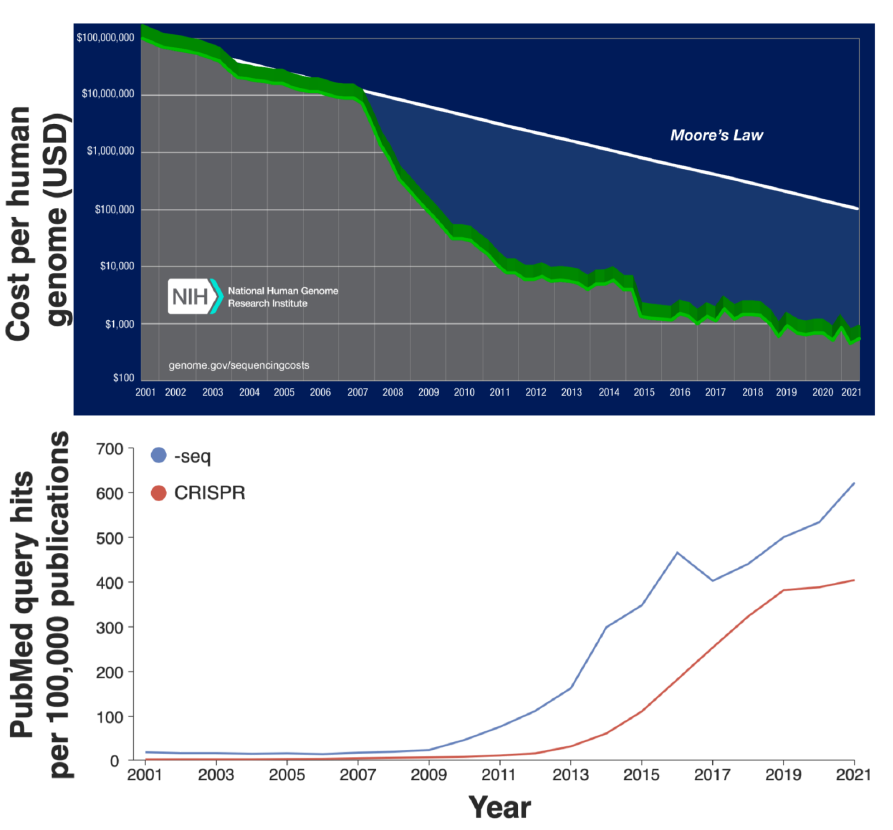
The genomic revolution did more than provide a list of genes. It supplied reference sequences and experimental collections that changed what could be tested systematically. Protein interaction studies could examine a defined search space, rather than only proteins already prominent in the literature. These maps revealed networks and molecular complexes, and provided starting points for questions about gene function and disease.
Yet the advances that made genomes and transcripts readily measurable did not transfer directly to proteins. Compared with DNA, proteins are difficult to handle and manipulate. Sequencing could extract enormous amounts of information, but the biological phenomenon of interest was not necessarily present in a form that could be sequenced.
I became interested in converting such phenomena into a sequenceable format. A molecular identifier can represent a component; a linked record can represent a relationship. The important information is no longer only which identities are present, but which identities belong together. This distinction becomes especially consequential when many experiments are mixed into a common pool. Preserving the relationship is part of the measurement problem.
The broader pattern was already visible beyond protein interactions. Sequencing technologies were being used to ask questions in microscopy, neuroanatomy, embryogenesis, and cancer biology. Their usefulness depended on experimental transformations that made the relevant biological information accessible to sequencing. My work in the Roth lab grew from that same idea, applied to the combinatorial space of protein contacts.
A map is a starting point
A protein interaction map represents proteins as nodes and relationships as edges. This is a useful abstraction, but an edge must mean something experimentally. Direct contact, membership in the same molecular complex, and spatial proximity are related observations, not interchangeable ones. The representation is only useful when we retain the distinction between them.
Nor is the resulting map a complete description of the organism. Even an extensive map of potential contacts leaves open whether those proteins encounter one another in a particular cell, whether the contact occurs in a particular environment, and what consequence follows from it. Nevertheless, reference maps are valuable precisely because they turn many isolated observations into an organized search space for the next question.
The ambition of my thesis was to move further along this path: from measuring individual components, to measuring their relationships, to asking how those relationships change. I developed and benchmarked growth-independent interaction assays, then worked with collaborators to apply them across biological contexts. The goal was not simply a longer list of interactions. It was to bring a changing layer of cellular organization into the range of systematic measurement.
The genotype–phenotype problem is often described as a gap between a sequence and an outcome. I see within that gap a series of experimental questions about relationships. Which ones have we measured? Which ones have we assumed? Which ones become visible only when the environment changes? These are questions that a list of parts, however complete, cannot answer on its own.