Research
CURRENT WORK · vGPS
Delivery is a problem of place
A treatment needs an address. The ambition behind vGPS is a whole-body atlas that makes the question of where it goes easier to ask—and harder to evade.
Read the research vision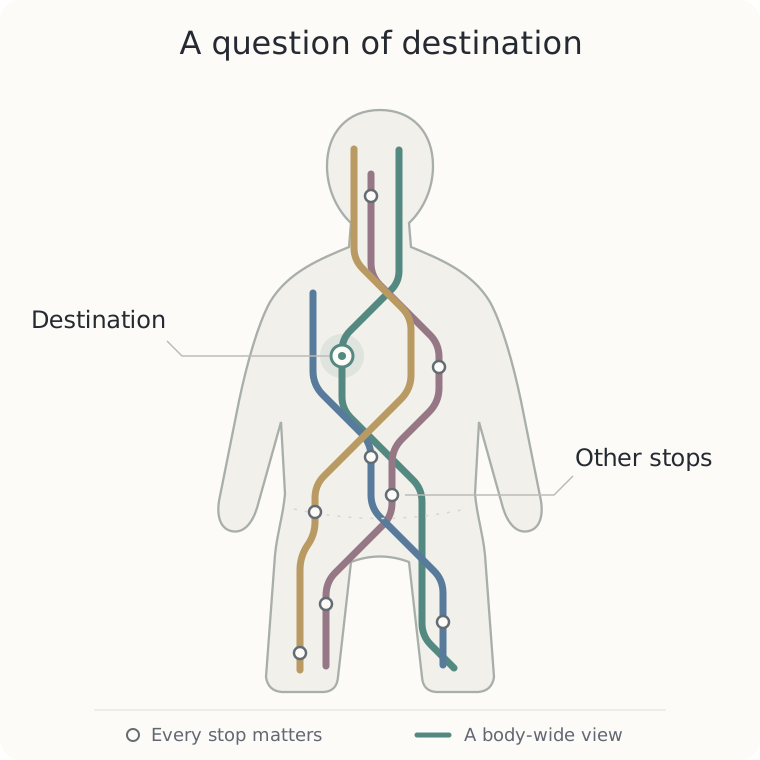
A study of natural yeast diversity examines how parental traits relate to offspring fitness across environments. It finds that the importance of parental fitness and genetic distance depends on growth conditions, alongside condition-specific mating affinities.
A genetic study identifies interactions linked to membrane-lipid signaling during sperm development in Drosophila.
A systematic map of interactions among bacterial effector proteins reveals relationships that targeted experiments had missed.
A systematic map of direct molecular contacts connects viral proteins with host pathways and human genetic evidence for disease severity.
The FlyBi and DroRI resources expand the reference map of direct protein interactions in Drosophila, creating a foundation for studying cellular pathways.
This study maps how amino-acid changes affect HMBS, a protein implicated in acute intermittent porphyria. The resulting functional evidence helps distinguish disease-associated from benign variants and illuminates relationships between protein sequence, structure, and function.
The Human Reference Interactome (HuRI) provides a systematic map of direct interactions between human proteins. Integrating this map with other biological data helps connect genetic variation with cellular functions and tissue-specific disease phenotypes.
A shared collection of viral coding regions provides a common research resource for molecular studies.
A proximity-based interaction map provides a complementary view of the molecular neighborhood of viral proteins in human cells.
Barcode Fusion Genetics uses sequencing to make pooled protein interaction screens more scalable.
Molecular simulations examine how changes in amino-acid stereochemistry alter a small peptide’s structure and energetics.