The interactome changes with its world
Two proteins can remain equally expressed while their relationship changes. A static map cannot tell us everything about a changing cell.
Network state and network wiring
Biological systems must continuously respond to internal and external changes to maintain homeostasis. Protein interactions are among the physical relationships through which this response is organized. If the organism changes with its environment, we should expect some of these relationships to change as well.
An established way to study this was to combine a static interaction map with measurements of changing gene expression. In effect, one extracts the part of the known network that appears active under a new condition. This is useful, but it carries an important restriction: it cannot identify an interaction that was never present in the baseline map.
It also cannot distinguish all changes in network state from changes in network wiring. Two proteins may be equally expressed across changing conditions while their interaction strength changes because of localization, post-translational modification, or other unmeasured variables. Knowing that both components remain present does not establish that their relationship remains the same.
This was the gap I wanted to address experimentally. A comprehensive view of interaction dynamics requires direct measurements across perturbations. We need to be able to observe relationships that appear, disappear, or change strength, rather than reconstructing every new context by subtracting from an old map.
Which conditions can the assay enter?
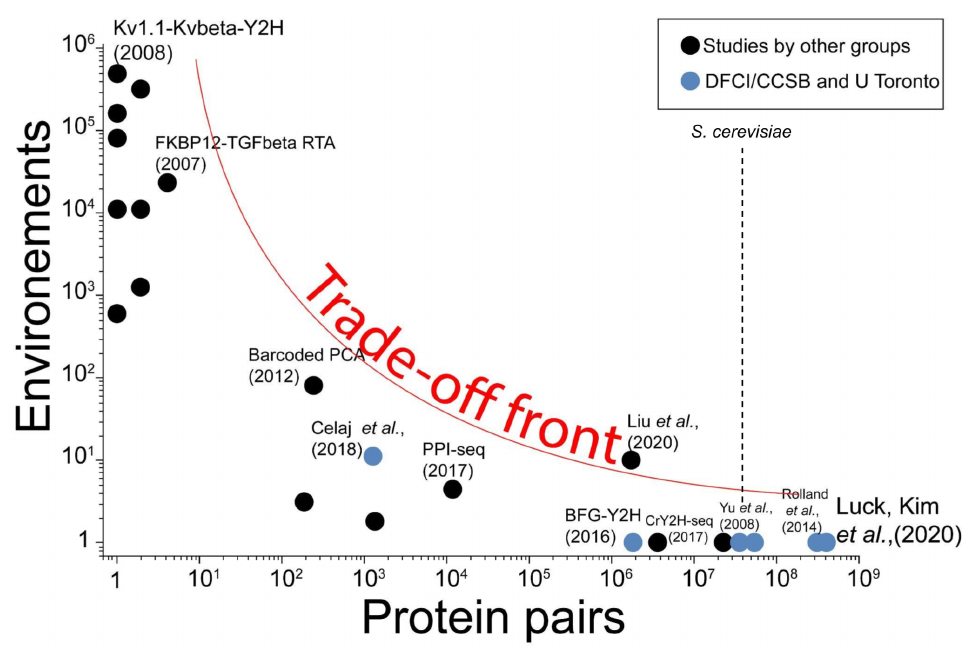
There was a practical trade-off between the number of protein pairs and the number of conditions that a study could examine. A focused study might follow a small set of relationships through many environments. A proteome-scale study might test an enormous search space in one condition. Moving towards the scale of both axes required a different experimental approach.
There was a second restriction: many scalable interaction assays used cell growth as their readout. But some of the most interesting biological conditions inhibit growth or arrest cell division. A measurement that depends on continued growth is poorly suited to understanding a response in which growth itself changes.
During my PhD, I engineered a growth-independent, massively parallel interaction assay and helped generate reusable experimental resources for screening at scale. The scientific purpose was to make these environments accessible, rather than allow the requirements of the reporter to decide which kinds of cellular response we could study.
With collaborators, I applied this approach to yeast protein interactions across baseline, DNA-damage, oxidative-stress, and carbon-starvation conditions. We first examined about two million protein pairs across thirty-one environments, then expanded to the roughly thirty-million-pair search space across four environments. Those numbers describe combinations queried, not interactions discovered. The pilot mattered because scale alone does not tell us which conditions provide distinct information.
Each environment leaves a fingerprint
The pilot maps allowed us to ask how much each additional environment contributed. Some environments had related interaction profiles, consistent with their perturbing similar cellular functions. Others provided less redundant views. We used those relationships to choose conditions for the larger screen.
There are two different kinds of information here. One is the discovery of a relationship we had not previously observed. Another is the pattern in which already known relationships change together. An environment can contribute little to the first while contributing substantially to the second. A familiar set of proteins, differently connected, can provide an informative view of a cellular response.
That is why I described each environmental interactome as a fingerprint of a particular cellular state. A catalogue asks which interactions can occur somewhere. A set of conditional maps asks what distinguishes one state from another. Collapsing those maps into their union preserves the catalogue and discards much of the distinction. The purpose of measuring many environments is therefore larger than collecting new edges.
Our measurements suggested a network in which much remained robust while a smaller component changed reproducibly across the tested conditions. I considered an interpretation in which cells achieve substantial plasticity through comparatively limited rewiring. But the fraction is inseparable from what the assay observes and from the environments sampled. It should not be turned into a universal percentage of all cellular interactions.
The topology of the changing component can also matter more than its size. Changes involving a key regulator may reorganize how cellular functions connect without replacing most of the network. In my discussion, I asked whether dynamic relationships could link functional modules, or whether proteins outside stable complexes might regulate those complexes in an environment-dependent manner. Those were hypotheses raised by the maps, not conclusions already established by them.
From correlated changes to a mechanism
A large map can reveal global patterns that remain invisible in studies focused on a handful of proteins. Yet its value also lies in providing specific, testable explanations. To move between these scales, we collected interaction, transcriptome, and phosphoproteome measurements in corresponding conditions.
These modalities can suggest a sequence of events. A regulatory protein changes in abundance; a potential substrate changes in modification; the substrate changes its interaction. Taken separately, each observation is a correlation. Taken together, they can narrow the space of mechanistic explanations and indicate which link to test next.
In the thesis, I followed one such example involving a metabolic enzyme whose self-association changed with its environment. Measurements at several levels suggested a regulatory model, and follow-up experiments tested predictions of that model. I found this movement between an atlas and an individual mechanism especially satisfying: the global measurement supplied the question, while the focused experiment examined the proposed explanation.
There are many directions in which such maps could be extended. Comparing physical interaction changes with genetic interaction changes could connect molecular contacts to functional consequences. Repeating measurements across genetic backgrounds could address more of the gene-by-environment problem. But the central lesson is already clear: a reference interactome is a foundation. To understand a responding cell, we must also ask how its relationships change with its world.
This is also why I hesitate to imagine a personal genome as a finished molecular explanation of a person. A sequence identifies possibilities; the relationships through which those possibilities are expressed still depend on context. My thesis ended with the prospect of supplementing personal genomes with measurements of molecular relationships. The value would lie in understanding which parts of an explanation change with the individual, which change with the environment, and which are shared. The combinatorial problem becomes larger as we add those dimensions, but the question becomes closer to the biology we wanted to understand in the first place.