From static snapshots towards dynamic movies
A measurement can preserve the parts and still erase their order. The temporal resolution of an assay determines which cellular events become visible.
The galloping horse
A horse can look convincingly fast while moving in a way no horse ever does. In Géricault’s 1821 horse race, the animals stretch across the canvas in the familiar flying gallop. The picture carries the feeling of speed. That does not make it a record of the stride. In 1878, Muybridge’s successive photographs made the movement available for inspection. All four hooves leave the ground, but with the legs gathered beneath the body. The familiar image had combined phases of the movement into a pose the movement never contained.
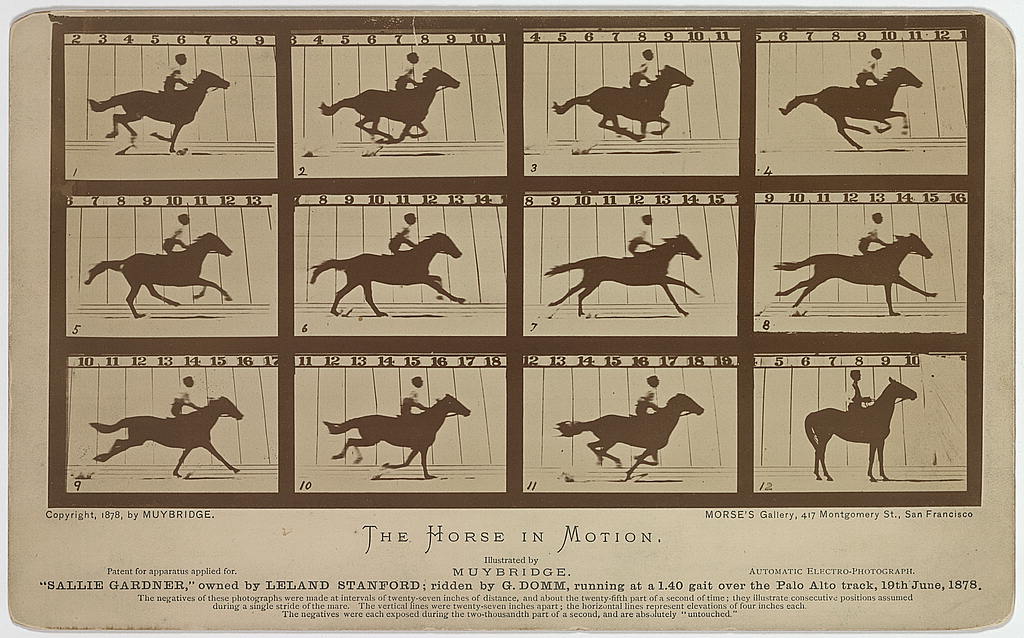
The important change was not simply a sharper picture of a horse. It was a representation of the order in which its positions occurred. An individual image could establish a posture; the sequence could reveal a gait. Something familiar to the eye became available to a different kind of question.
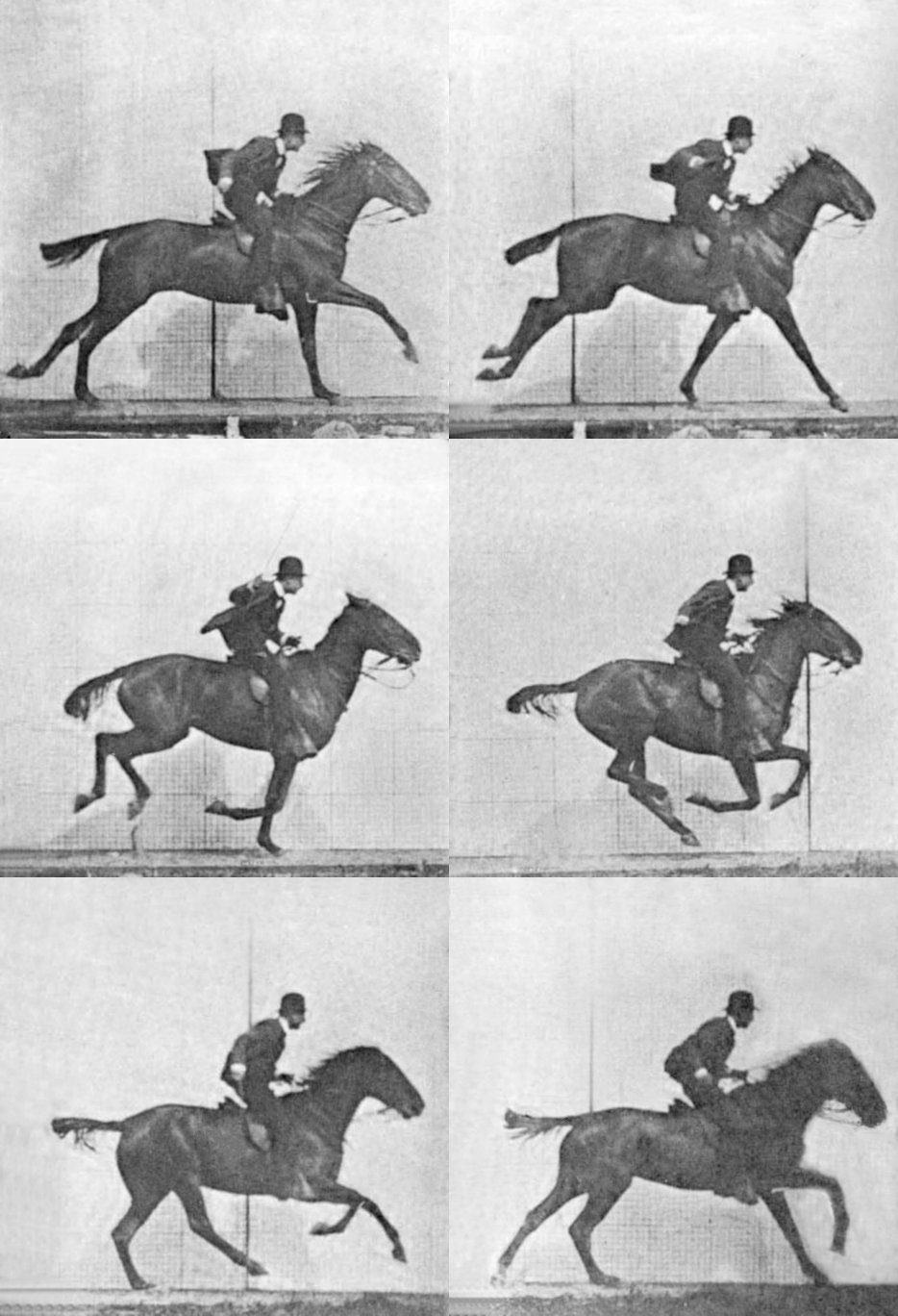
I used this example in the concluding chapter of my thesis because dynamic movies of protein interactions could reveal analogous corrections. A static representation may contain the right components and still arrange their relationships into a state that does not occur in that form. What happens together, what follows what, and what exists only briefly can be difficult to infer from a time-averaged measurement.
The analogy has a limit worth preserving. A time-averaged protein map does not necessarily invent an impossible contact. It may record genuine relationships that happened at different moments and display them together. The error begins when we read their coexistence on the page as their coexistence in the cell. An atlas can tell us what occurred during an interval while leaving open whether one relationship preceded, enabled, or followed another.
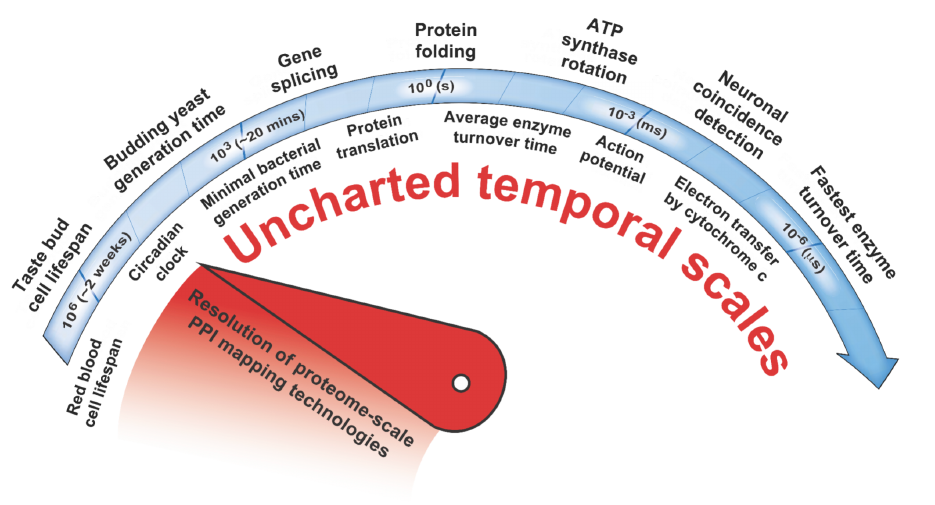
Many cellular events take place within minutes or seconds. Proteins are recruited in an order, assemblies form and dissolve, and responses peak before returning towards baseline. A map collected over a much longer interval can preserve evidence that a relationship occurred while obscuring the sequence in which it mattered.
The difficulty is not that static maps lack value. They have guided hypotheses and revealed cellular organization for decades. It is that the temporal questions we want to ask are not all contained in a static observation. To answer them, we need a measurement with an appropriate relationship to the timescale of the process.
The reporter has a history of its own
An interaction assay does not report a contact instantaneously. The signal passes through a chain of events. Depending on the system, these can include transcription, translation, maturation of a reporter, accumulation of the signal, and cell growth. Each step introduces a delay or preserves a trace of earlier activity.
Growth-based readouts were particularly limiting for the problem I wanted to study. They could average a response across days while the relevant signaling event faded within hours or minutes. Growth independence made new environments accessible and improved the timing of measurement, but it did not remove every delay.
The clock belongs to the measuring system as well as to the cell. A brief event can leave a long-lived signal; two successive events can merge into what looks like one sustained state. Asking for a faster map therefore means more than collecting the same output more frequently. We have to ask what period of the cell’s history each observation actually represents.
A fluorescence reporter still has to be produced and mature before it can be measured. It can also persist after the initiating event has ended. Its signal therefore reflects something about the recent past, not only the current state of the interaction. When the biological response is faster than these reporter dynamics, important changes become difficult to resolve.
This prompted my work on a messenger-based interaction readout. The concept was to exploit the rapid production and turnover of RNA to shorten the path between a protein interaction and a sequenceable signal. The aim was not merely to obtain another measurement of the same accumulated output, but to make shorter-lived events experimentally accessible.
From a concept to a demonstrated timescale
My thesis established a proof of principle for detecting protein interactions with this messenger-based approach in a heterogeneous pool of protein pairs. It also developed resources intended to support larger-scale applications. These results made the concept experimentally tangible.
The proposed minutes-scale resolution, however, required a separate demonstration. The thesis included theoretical estimates based on earlier empirical measurements and simulations, while the experiments intended to establish turnover directly were inconclusive. A proof that a reporter can detect an interaction is not yet a proof that it can resolve every rapid change in that interaction.
This distinction mattered because faster turnover brings another trade-off. A long-lived signal can average fluctuations and make a measurement more stable. A shorter-lived signal can retain more temporal information while becoming more variable. The desired temporal resolution, the reliability of the signal, and the scale of the experiment must be considered together.
I therefore described the messenger-based system as paving the way towards dynamic maps, with further experiments needed to establish its practical resolution. The exciting possibility was a proteome-scale view of relationships changing over minutes. The work in the thesis was a step towards that possibility, rather than an already completed movie.
What would the movie let us ask?
Even fundamental questions about interaction dynamics remained open at the scale of whole networks. What fraction of an interactome rewires in response to a stimulus? How much of that response is stimulus-specific? Which regulators mediate the rewiring? How rapidly do different relationships change? Answering these questions requires comparisons across contexts and time, not simply a more detailed picture of one condition.
The cell cycle is one example. Cell division is a temporally regulated process, and its study has shaped our understanding of cancer, stem cells, and aging. Yet changing levels of individual transcripts, proteins, or modifications provide only a partial view. Cellular events also depend on the dynamic contacts through which those components act.
Consider an assembly whose components are recruited one after another. A catalogue could contain every member and every pairwise contact, yet leave the order of assembly unresolved. Different orders may imply different explanations of the same final structure. This is why I am interested in measurements that retain history: the route by which a state is reached can be part of what makes that state intelligible.
A sufficiently resolved interaction map could ask how the network reorganizes as a cell progresses through division, and how regulatory changes are connected to that progression. It would also need to distinguish normal temporal organization from effects introduced by the experimental means of observing it. The measurement should not manufacture the sequence it is meant to discover.
The wider perspective of the thesis was to connect several dimensions of cellular organization: genotypes, environments, and time. Each additional dimension creates a larger combinatorial problem, but it also makes the biological question more faithful. The ambition is to learn how cellular machinery changes in response to internal and external events. A movie is a useful image for that ambition because it reminds us that an organism is not only an arrangement of parts. It is an arrangement continually doing something. The question also returns in my philosophical notebook: what information disappears when a developing process is replaced by its final formulation?