An argument for the fractal structure of consciousness
There is something. Something perceives. But what happens when the perceiver tries to perceive itself?
A thought in development
This is not a final statement. It is a thought in development, mapping itself into written language and trying different isomorphic “molds.” In writing it down, I am trying to preserve something that a finished formulation can easily erase: the temporal ordering of the ideas, the history of how the thought acquired its present structure.
For a gradually changing dynamic system, the developmental perspective may be one of the most crucial pieces of information. A statement has a history too. The version that finally makes sense is not necessarily the version that tells us most about how sense was made.
I want to begin with an apparently trivial sentence and follow it into a less trivial problem: what kind of structure would allow a perceiver to perceive itself?
This sentence does exist
This sentence does exist.
There seems to be no conceivable scenario in which this particular sentence could exist, make its statement, and be false about its own existence. As soon as one refers to “This sentence does exist,” even in an attempt to show that it does not, the sentence pops into existence.
One may object that, if referring to something implies its existence, anything can be brought into existence by referring to it. “Unicorns do not exist,” for example, refers to unicorns. Have we now brought unicorns into existence?
The difference is the medium in which the thing is claimed to exist. A necessary condition for a physical unicorn is its existence in a physical medium. As far as I can conceive, a necessary condition for the existence of this sentence is already satisfied in a written or mental medium. As soon as the mind understands its meaning, the sentence exists in that medium. That is a considerably more modest existence than a unicorn would require.
What if no mind understands the sentence? Then it might fail to exist as an understood proposition. But it could not simultaneously fail to exist as a proposition and make a false statement. If it makes no statement, it is neither true nor false about that statement. The argument concerns the interpretation that actually refers to the sentence itself; a different interpretation is a different claim.
I am treating this as a tautology within a system that already permits a sentence to refer to its own existence. It is always true when that self-referring statement is made. This is a strange place to start because the act of stating it is part of what makes it true.
Now consider another sentence: “There is something.” Something cannot be written, said, or stated when there is absolutely nothing. If this sentence exists, it is already something. Thus, in every situation in which it can make its claim, the claim is satisfied.
“This sentence does exist” is something. If the former exists, then something exists. It is impossible even to ask whether a statement is true if there is no statement. The apparently empty assertion “There is something” acquires a peculiar certainty from the conditions of its own assertion.
The perceiver has a structure
In order to perceive anything, there must be something that perceives and something that is being perceived. Both are, of course, something. The question is what distinguishes the two.
Suppose a perceiver is defined by an interaction with something other than itself. Then it must have a constrained structure. It cannot be everything and, in that same relation, perceive something outside itself: there would be nothing outside to perceive. In this picture, perception is constrained—limited, and therefore biased—by the structure that makes it possible.
The perceiver must contain something corresponding to the thing being perceived. I have been thinking of that correspondence as an isomorphism: a resemblance of structure that allows one pattern to carry information about another. I am using the idea broadly here. The important point is that a perceiver cannot receive information about a particular thing while having no relationship at all to that thing.
One can draw an analogy to the role of analogy itself in cognition. To recognize a pattern is to find some correspondence between what is encountered and a structure through which it can be understood. The perceiver does not simply admit the world untouched; it has a form into which the world can be admitted.
What, then, would it mean for a perceiver to perceive itself? It would need a model corresponding to its own structure. But the moment that model is created, the perceiver changes: it now contains a model that the previous perceiver did not contain.
The first model therefore corresponds to a previous instance of the perceiver. Make a newer model that includes the first, and the structure changes again. That newer model is itself another part of the structure it is supposed to represent. We can keep going: a model of a perceiver, a model of the perceiver containing that model, a model containing both.
Unless the structure takes a different form. What if the perceiving structure were self-similar? Once a model were made, could its relation to itself already be contained in the pattern, because the pattern repeats across levels? This is the possibility that led me to the image of a fractal: perceiver and perceived coexisting in the same recursive structure.
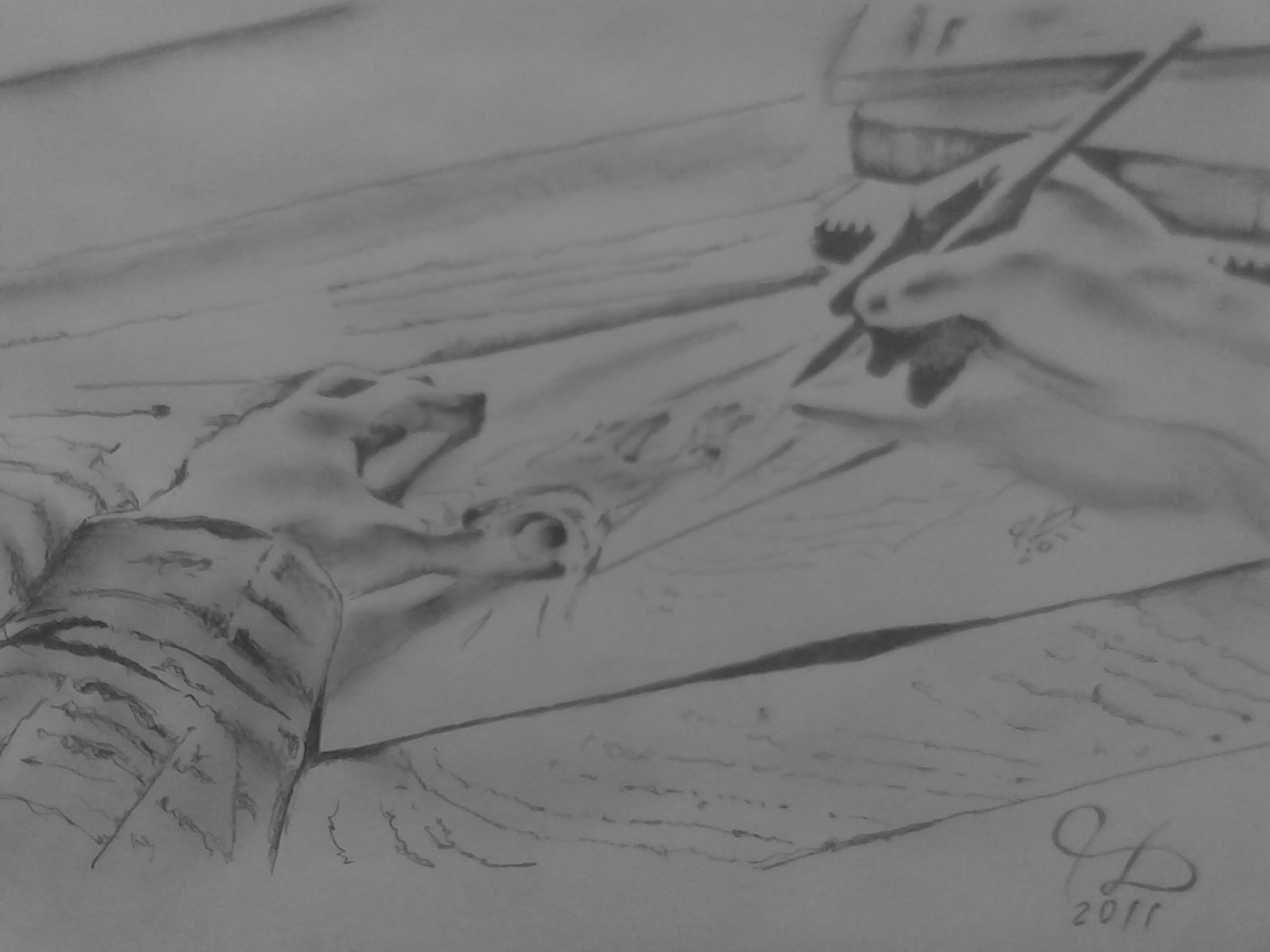
My drawing, “Drawing the drawing,” is an attempt to give that question a visible form. A hand draws a picture of the act of drawing; the picture contains the picture, and the scale changes while the relation remains. What interests me is the difference between adding another item to a hierarchy and giving the hierarchy a repeating structure.
If a perceiver were perceiving only itself, the initial distinction between perceiver and an outside object would change. Perceiver and perceived could occupy the same system. As far as I can conceive, this is the exceptional scenario worth examining: a structure whose relationship to itself is part of the structure, rather than something added from outside.
A stick that tries to touch itself
Let us imagine an entity inside a world, independently of the particular nature of that world, with only the premise that there is an outside. Let us also imagine that the entity perceives this world through a stick. Every time the stick interacts with something, another bit of information becomes available to the entity.
In this arrangement, how does the entity acquire information about the stick? The stick encounters the outside world, but it does not encounter itself in the same way.
We could give the entity a fancier robotic stick—one that extends, turns around, and touches itself. Then the entity could perceive bits of its own perceptive tool. But have we solved the problem, or delayed it by constructing a greater hierarchy of perceptions?
There would still be a part of the perceptive arrangement doing the touching. That part would have to be encountered by something else to enter the description in the same way. Extend the tool again, and the question returns at the new endpoint.
Reason is also a tool through which we encounter the world. Experience, belief, emotion, and feeling offer other ways. The stick analogy makes me ask what happens when we demand that one tool completely account for itself using only its own operation. Where is its endpoint? What aspect of the operation remains outside the account?
I am ten squares tall
The power of analogy can be demonstrated with an analogy.
Imagine a measurement device with a prior structure. For simplicity, suppose that structure is a perfectly two-dimensional square with an arbitrary side length a. Measurements are then carried out in terms of squares.
The results contain information about the measured entities, certainly. But that information has been merged with information about the square before it is born as a final measurement. I am ten squares tall and five squares wide: true, but the curvatures around my shoulders, elbows, ears, and fingers are masked by “squareness.”
We can decrease the size of the square. We can also keep asking about finer curvatures. The question that interests me is whether improving the quantity of the measurement always improves the kind of information it is capable of representing. What would a measurement look like that had a different prior structure?
Imagine upgrading the device by adding more shapes. The hope would be to reduce the chance that the final measurement is masked by the limitations of any one shape. This resembles the purpose of independent measurements in empirical science: when differently limited ways of measuring agree, the agreement is more informative than a repetition of the same limitation.
But how should we start picking the shapes? Every shape can be converted into another by adding a point. The search space does not politely end. Is random search the best solution?
A more pragmatic strategy might begin with a few square-based measurements. We would then look for something common among the measured entities that is also different from the square. A new shape resembling that common feature could help optimize the instrument toward entities we frequently encounter.
The difficult part is finding that “something common”—the pattern, or essence, if you like. We need to recognize a relation that is shared across apparently different things and transfer it into the structure of a new tool. Analogy is responsible precisely for that miracle.
Two worlds, two classifications
Imagine two worlds in which scientists measure the radiation emitted by an unknown entity. Their instruments have limited resolution. In the first world, the radiation is classified as blue light. In the second, it is classified as ultraviolet.
Suppose the other measurements available in each world share limitations that support its original classification. All the evidence in one world says blue; all the evidence in the other says ultraviolet. The worlds could put the entity to different uses. Those who understand it as higher-energy radiation would approach it differently.
An obvious solution is to suppose that there is a true wavelength independent of either measurement, and that a better tool in a third world could establish it. But suppose neither world has access to better tools or to that third world.
Is there any way for scientists in either world to conclude that their measurements are limited and do not reflect the true wavelength? What would make their limitation visible from within the world it has helped them construct?
I am especially interested in a further possibility: what if every piece of evidence supporting a classification also turned out to be useful to the inhabitants of that world? Would that convergence be reassuring, or suspicious? Are we discovering the world, or discovering the shape of our usefulness within it?
These questions return us to the perceiver. A point of view is a point from which something can be seen, and from which something else cannot. Different points of view may reveal different facts, and different facts may invite different interpretations.
The metaphorical category of perspective seems to carry a deep analogy to its physical meaning: a position in space and time constrains the view in a particular way. In practice, a finite person can never evaluate every viewpoint they might conceivably take. The space of interpretations remains inexhaustible from inside a human life.
That is why the developmental history of a thought matters to me. A finished statement shows where a mind arrived. Its earlier forms can show which structures made the arrival possible—and where another structure might still lead.