Better Questions for Scientific AI
Progress depends on matching the model, the evidence, and the question—then seeking observations that could change the answer.
Learn from a real success
Protein structure prediction is a powerful reason to resist blanket judgments about scientific AI. Jumper and colleagues' 2021 AlphaFold paper reported a major advance in predictive accuracy, combining substantial scientific data with architecture and training informed by evolutionary, physical, and geometric constraints. The achievement is important on its own terms. Describing every successful prediction as a sophisticated lookup understates what a model can learn from structured evidence.
The scope of the target helps explain why its evidence is strong. Experimentally determined structures provide paired examples of sequences and structural outcomes. Evolutionary relationships contribute additional patterns. Geometric constraints reduce irrelevant variation: moving or rotating a representation should not change the underlying structure it describes. The design of the model and the organization of the data work together.
This does not establish that the full dynamics of folding have been recovered. A useful prediction of a structure differs from a complete account of its formation, movement, or behavior across conditions. Proteins can have multiple relevant conformations, and a predicted structure does not automatically verify function. Keeping these distinctions clear preserves the achievement while showing which questions still require other forms of evidence.
An endpoint and a process ask different things
The original comparison with development turns on the target, rather than a judgment that one field is simple and another is impossibly complicated. Predicting a recorded endpoint can be evaluated against endpoints. Predicting a trajectory asks how a system changes through time, potentially depending on history and context. A collection of states may inform that question without uniquely answering it.
Even the endpoint comparison needs qualification. A sequence does not specify one universally fixed structure independent of its environment, and no finite collection of structures guarantees identification of every unseen case. Likewise, a developmental process can be modeled as a mapping when the relevant initial conditions, inputs, and uncertainty are included. The important issue is whether those ingredients are observed or justified for the prediction being made.
Evolutionary covariation is also informative without being a literal record of randomized experiments. Related sequences share ancestry, and observed variation reflects many influences. Models can exploit the resulting constraints successfully while causal interpretation remains more demanding. The practical question is what kind of information a source contributes and what dependencies it leaves unresolved. Raw counts of examples do not answer that question; redundancy and coverage matter to the evidence available for a particular target.
Seeing, doing, and imagining
Causal reasoning distinguishes several kinds of question. Observation asks what tends to accompany what. Intervention asks what changes when a variable is deliberately altered. A counterfactual asks what would have happened to a particular case under circumstances different from those that occurred. Judea Pearl describes these as different levels of a causal hierarchy, with different informational demands. His introduction to causal inference explains how causal assumptions connect data to those questions.
Observational records alone, without causal restrictions, need not identify an intervention effect. That is different from saying observational causal inference is universally impossible. Assumptions about relevant variables, temporal order, or the absence of certain confounding can make some effects identifiable. The assumptions should be stated and assessed, rather than hidden inside a confident interpretation of a correlation.
Intervention data can break ties, but it does not remove every ambiguity. An average response to a change may leave individual counterfactuals unresolved; results in one context may not transfer to another. The hierarchy is useful because it makes the target explicit. It reminds us that predicting a likely observation, estimating a change's effect, and explaining an unrealized alternative are different commitments. A model should be evaluated at the level of the commitment it makes.
The pond and its ripples
A reservoir provides a vivid image of why dynamic computation and causal knowledge are different things. Imagine dropping pebbles into a pond. The surface responds with overlapping ripples, carrying traces of recent disturbances. An observer might use the changing pattern to predict the next part of a familiar input stream. A rich internal response can make information easier to read without determining the external process that produced the stream.
In a computational reservoir, an input drives a dynamical system and a readout uses its changing state. Such a system can be useful. Its capacity is not adequately described by saying it only copies, or by assigning every reservoir the same memory limit. The relevant point is narrower: complexity inside the receiver does not automatically supply evidence that distinguishes externally equivalent explanations.
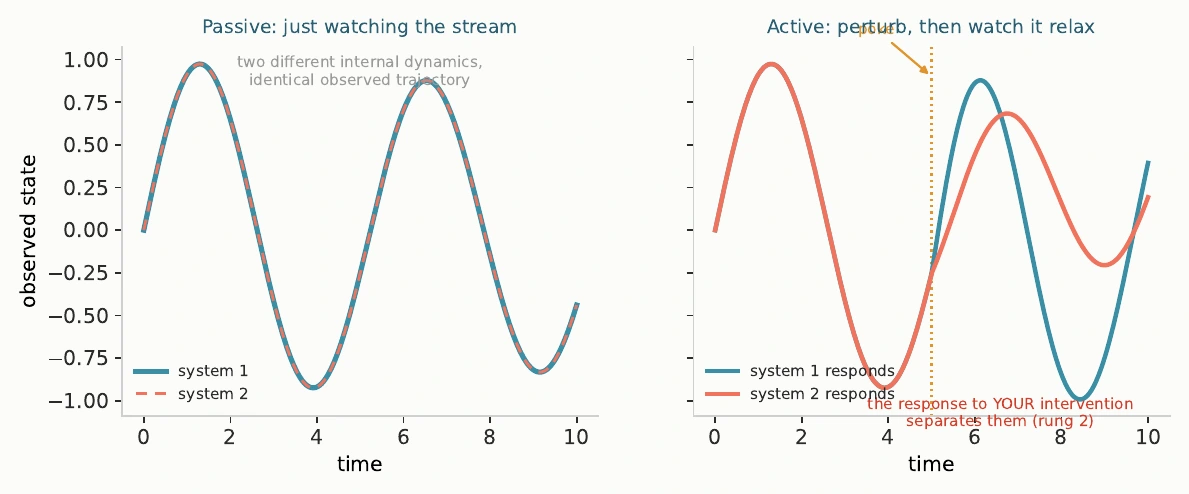
Suppose two candidate systems produce the same observed trajectory but respond differently to a particular change. Passively receiving that trajectory leaves them tied. Observing the response to the change can separate them. The illustration makes this conditional argument clear. It does not claim every passive record is uninformative or every intervention decisive. It shows why the next useful observation depends on where rival explanations disagree, rather than on how impressively we can re-encode the observations already available.
Gibson’s active observer
Perception offers a related lens. In The Ecological Approach to Visual Perception, James J. Gibson emphasized an organism's relation to its environment and the information available through that relation. For the argument here, the compelling image is an observer who moves. Changing viewpoint can reveal an edge, separate overlapping objects, or make a surface's geometry easier to perceive.
The observer has changed the information available by acting. This is a useful analogy for scientific inquiry: we do not merely receive a fixed pile of records but choose where to look and what question to ask next. Movement in perception is not identical to a formal causal intervention, and Gibson's theory should not be reduced to one rung of a statistical hierarchy. The shared insight is that information gathering can be an active process.
A model can participate in that process by exposing uncertainty or proposing observations that distinguish alternatives. Its recommendations still require assessment. Activity alone is not evidence of correct causal understanding, just as a dynamic internal state is not. The value comes from the relationship between the proposed observation and the unresolved question. We learn more when the new view is chosen because it can change which explanations remain plausible.
Two priorities for useful progress
Two priorities run through this series. Give a model structure that matches the question, and seek evidence that can distinguish the explanations the question leaves open. Suitable structure can make useful representations and computations easier to obtain. Informative observations can challenge solutions that fitted the old record equally well. Neither priority replaces the other in every problem, and together they are not a universal guarantee of identification.
The work begins by specifying the target. What should be predicted, under which conditions, and with what uncertainty? Which simple alternatives already perform well? Which changes would test the intended generalization? Which assumptions connect the observed relationship to a causal interpretation? These are practical questions, not obstacles placed in the path of ambitious modeling. They determine whether an improvement means what we hope it means.
The central thesis is consequently a demand for a closer connection between achievement and explanation. Fitting patterns can be useful, difficult, and scientifically productive. It does not on its own select a unique mechanism from every set of observationally compatible alternatives. Understanding grows when we identify the unresolved choices and find evidence that bears on them. Bigger models may contribute to that work. Better representations, better evaluations, and better questions determine what their contribution allows us to conclude.